Existential horror is fiction that scares you with questions, like why you’re here and what happens when life ends.You’ve likely felt its pull lately, because more people feel unsure about life, and these stories give that unease a place to sit.
Think about the last time a book got under your skin. No ghosts. No blood. You finished the final page, put it on the table, and just stared at the wall for a while. Odd, right? That strange quiet is exactly why readers keep chasing this stuff, and it’s what the rest of this post digs into.
Why This Fear Feels So Different
Most horror hands you a problem. Find the killer. Leave the house. Burn the doll. By the last chapter you get to relax, and you probably make a cup of tea.
Existential horror does not always offer that kind of resolution. The threat may come from the universe itself and the way it works. There’s no door to lock and no one coming to rescue you.
What Actually Scares You
The strongest existential horror themes come back to a short list of fears:
- The fear of existence, which is just being alive with no explanation attached
- Cosmic insignificance, where you shrink to a dot in a universe that never noticed you
- Loss of purpose, that moment a goal you worked on for years stops mattering
- The absurdity of existence, when your daily rules and habits start looking made up
You can’t beat any of these. You look at them for a while, then close the book.
Why Dread Hangs Around
A jump scare is gone in two seconds. Existential dread in horror can stay with you for a week. Authors build it from boring things. A kitchen at night. A hallway light that flickers once. A phone that never rings. Nothing happens, and somehow that feels worse than a scream.
This lingering uncertainty is also what makes the fear of the unknown so powerful in horror.
What’s Pushing You Toward It
Horror has always borrowed from whatever was bothering people at the time. Cold War nerves gave readers paranoia stories. The early internet gave them haunted screens. Today the worry sits closer to home:
- Every news alert reminds you how breakable things are
- Burnout makes you wonder if your job matters at all
- Hours of scrolling can leave you feeling oddly alone
- The past few years made death an ordinary topic at dinner
When life feels shaky, a story that admits it can seem more honest than a cheerful one.
Facing Death From Your Sofa
Most of you carry some fear of death and keep quiet about it, especially at work. Fiction lets you look at it from a comfortable seat. That’s a strange kind of kindness, if you think about it. Horror and human existence have long been connected, and some writers explore the fear of human mortality directly, with or without supernatural threats.
Nobody to blame. Just the fact that your time has an end.
You can spot it outside books too. Remember the long, slow speeches in True Detective? Or SOMA, the game that makes you ask what being alive even means? Nobody stuck around for the scares there.
Big Questions in Your Feed
Short clips, quote cards and quick reviews travel fast. One unsettling paragraph can reach thousands of people before dinner, and you pass it along because it says what you already felt. The old question about the meaning of life now lands in your feed between a recipe video and an ad for shoes. Writers noticed that gap. They write straight into it.
Few figures carry the weight of endings like death itself does. In religions and folklore, it marks the moment a life stops. In horror it often means more, because it’s the one certainty you can’t bargain with.
Sometimes death is portrayed as cruel; at other times, it appears calm or gentle. That quieter portrayal can be unsettling in its own way. For more on this symbolism, read The Angel of Death: Meaning, Symbolism, and Role in Horror Stories.
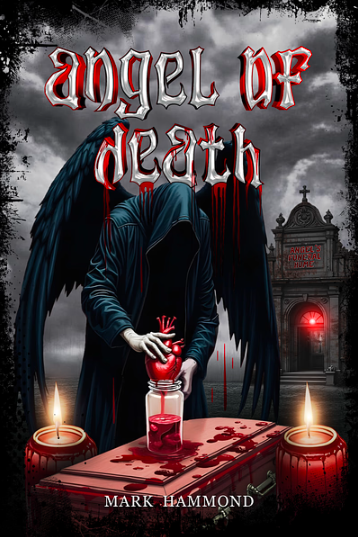
Mark E. Hammond explores themes of fear, faith, guilt, and mortality in his book Angel of Death.
What the Symbol Stands For
- Death as a deadline nobody can move
- Judgment with no explanation and no appeal
- Human mortality as the one rule nobody gets around
When a story handles this figure well, you stop asking who wins. You start asking what you’d do with your own time.
Where You Can Start Reading
New to this? Go short. Existential horror books can feel heavy, so a novella or a story collection is a softer way in. Philosophical horror stories also work well at short length, since one sharp idea can hit hard in ten pages. You don’t need three hundred pages to feel small.
For a few existential horror examples, try H. P. Lovecraft’s cosmic tales, Thomas Ligotti’s short fiction, or Franz Kafka’s The Metamorphosis. Each makes you feel small in a different way. Pick whichever sounds least comfortable.
Signs a Story Fits
Existential fear in fiction usually creeps in quietly. Watch for these:
- No clear villain, only a situation nobody can fix
- An ending that won’t explain itself
- Characters who start asking why they exist at all
- Ordinary places that feel wrong for reasons you can’t name
Reading It Without Feeling Worse
This genre is meant to unsettle you, not wreck you. A few habits help:
- Read in daylight or early evening, not at 2 a.m.
- Take a break between chapters so the ideas can settle
- Talk about what you read with a friend or a book club
- Swap in something lighter now and then
If a story leaves you low for more than a few days, put it down. Feeling unsettled is normal. Feeling stuck means you need rest.
Final Thoughts
You do not read such material for enjoyment or to be frightened. You read it because it tells you things that your normal life cannot allow you to express. It converts a vague fear into something tangible that you can ask questions about and eventually put away from you.For more stories exploring fear, faith, and mortality, read more from Mark E. Hammond.
FAQs
Slasher stories often focus on a threat that characters may escape or defeat. Existential horror explores deeper fears about death, existence, and meaning, which can stay with readers after the story ends.
Not necessarily. Some readers enjoy facing their fears through fiction. However, if the themes leave you feeling negative or anxious, take a break and talk to someone you trust.
Start with a short story or novella to experience the genre before committing to a full-length novel.